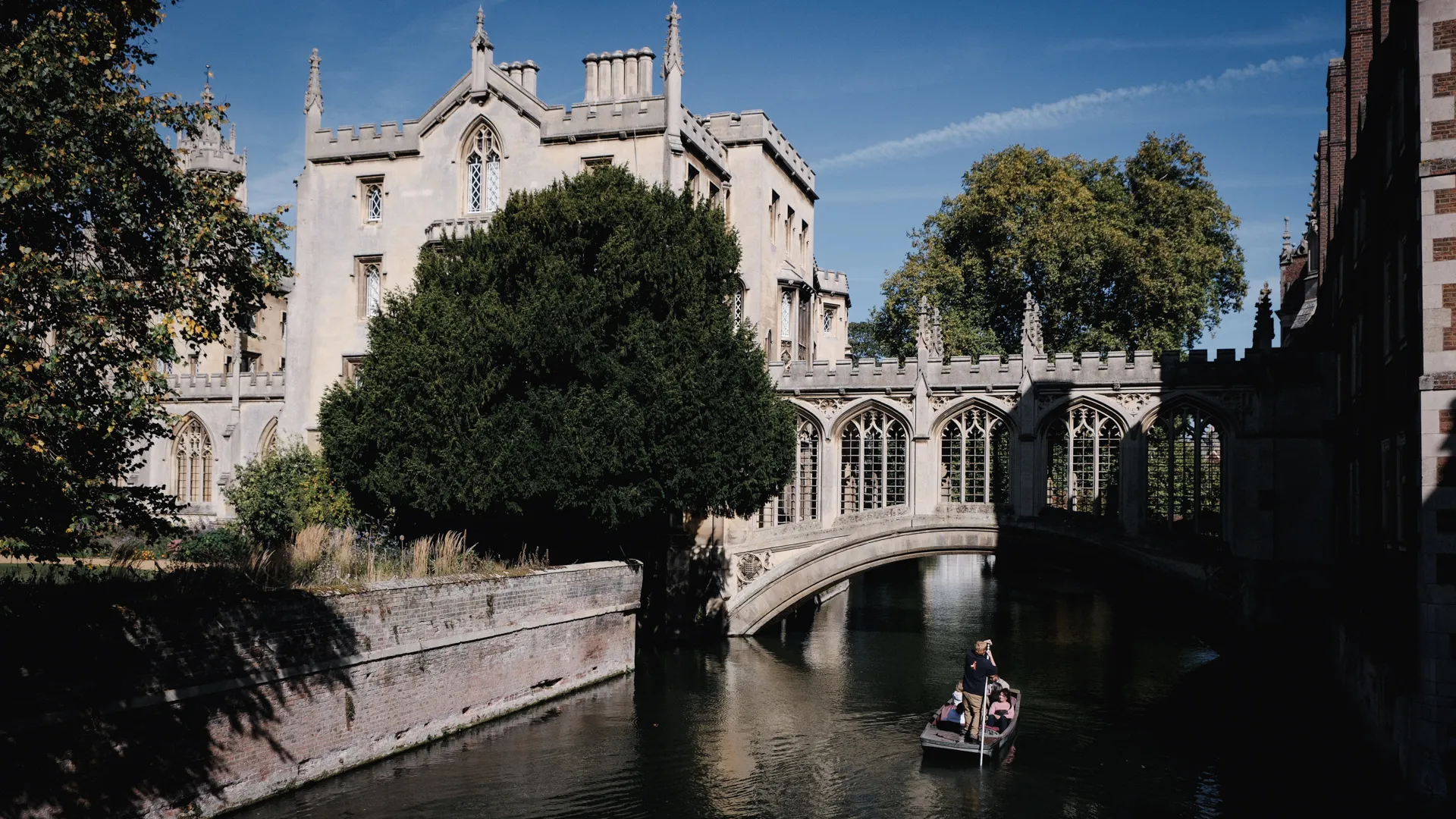
Every punt company on the river covers the same mile-long route past the same colleges. Yet somehow, two people can take the exact same tour and walk away with completely different memories — one as a highlight of their trip, the other as a wasted hour.
Punting is one of the main reasons people come to Cambridge. There is genuinely no better way to see the college Backs — that stretch of river behind all the old colleges that somehow looks even better from a boat. You will spend an hour drifting past some of the most stunning architecture in the country while someone else does all the work. It’s brilliant.
But here is the thing — punting is also a business. And like any business in a tourist town, it gets complicated.
Show up in Cambridge on a summer Saturday and you will quickly notice there is a lot of competition, some genuinely good operators, and also some pretty creative ways to separate you from your money if you are not careful. Touts at the station marking everything up. Kiosks charging twice what you would pay if you just walked to the boat. Companies hiring new guides and throwing them on the river after two weeks of training. It is not exactly a disaster zone, but it definitely helps to know what is happening.
Ten years on this river, and I have picked up enough to help you avoid the traps. This guide covers everything I would tell a friend visiting for the first time — what you are actually getting into, what you will see, which companies are genuinely worth it, what to avoid, and how to make sure that hour on the water is actually memorable.
What Is Punting?
A punt is a flat-bottomed wooden boat, and one person stands at the back with a pole and pushes the whole thing along. That is essentially all there is to it. No oars, no engine, no current doing the work — just the pole, the water, and whoever has got the strength to keep things moving.
If you have been to Venice, you might think of a gondola — and that is a decent starting point, but it is not quite the same. The River Cam is shallow and still, the boats are wider and way more stable, and the guide stands instead of sitting. Less drama, way more relaxed.
A standard tour is roughly a mile of the river, taking you through the college Backs and back again. The whole thing takes about 45 minutes. You sit down, they pole, they tell you stuff about the buildings, and you watch them slide past.
You can get a tour pretty much any time during the day. Most places open around 9am and keep punts going until dark. Winter’s a wild card as it is all weather dependent, except later opens and earlier closes. On a quiet weekday morning, you can usually rock up and be on the water within 15 to 30 minutes. But on a summer Saturday? You might be waiting hours, and the popular operators will be fully booked by mid-morning. If you are coming during peak season and have a specific time in mind, book ahead.
There are ten companies punting on the river — some are small with a handful of punts, others are basically corporations with fleets, branded staff, and the money to advertise everywhere. They all punt the same stretch of water. The difference — and it can be significant — comes down to what happens in that hour when you are sitting in the punt.
What Will You See? The Punting Route
There are three main spots along the river where punts depart — Mill Pond to the north, Garret Hostel in the middle, and Quayside further south. Whichever one you start from, you will end up going past the college Backs.
If departing from Millpond, you will see the landmarks in this order. Reverse the order if starting at Quayside.
Queens’ College & The Mathematical Bridge — this one gets asked about constantly. There is a whole famous story about Isaac Newton designing it, no bolts holding it together, fell apart when they took it down and could not rebuild it. Complete myth. Your guide will hopefully tell you what actually happened instead, which is interesting enough.
King’s College — this is the big one everyone recognises straight away. Massive perpendicular Gothic facade right there on the riverbank, impossible to miss.
Clare College & Clare Bridge — the second oldest college on the river, and Clare Bridge is the oldest surviving bridge on the water. Nice simple stone arch with those decorative stone balls along the edge. Legend says one of them is missing a bit. Whether that is actually true? Honestly, it depends which guide you get.
Trinity Hall — one of the smaller colleges but sits beautifully on the river, and you get a real sense of how these places are built right on the water rather than away from it.
The Wren Library — Christopher Wren designed this one and it sits right on the water. On a still day you can see the whole thing reflected back at you.
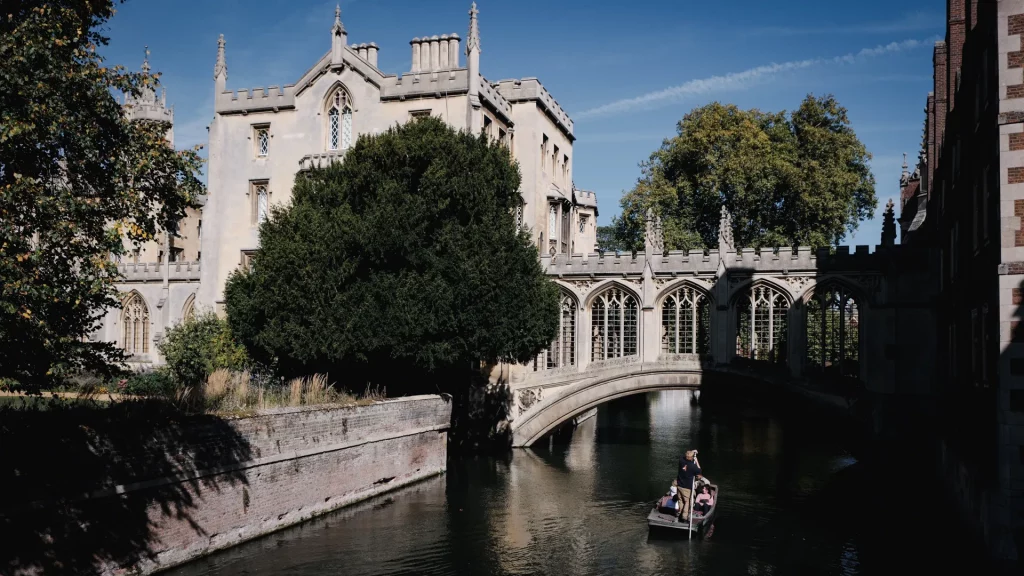
St. John’s College & The Bridge of Sighs — the most photographed bridge on the water. It is covered (like a little tunnel) and supposedly inspired by the one in Venice, except built a few hundred years later.
Quayside — this is where the Romans crossed the river two thousand years ago, and later where the docks grew up that basically built the whole city. Now it is where most punts start their day.
All of that in one hour. Without walking anywhere.
The lower river and the upper river
When most people say they are going punting, they mean the lower river — the Backs, the colleges, the whole guided tour experience. But the river keeps going in both directions, and they are completely different things.
Heading south towards Grantchester, the upper river is basically another world. The colleges disappear, the meadows open up, there are weeping willows everywhere, and it gets properly quiet — the kind of quiet you do not get anywhere near the city centre. No guides narrating up here. This is self-hire territory. Think slow afternoon, picnic, no real agenda.
So: if you are after the colleges and the architecture and the history, the lower river is your spot. If you want the actual river — the peace of it, the countryside — head upstream. Both are worth doing, and we cover both properly further down.
Guided Tour or Self-Hire?
There are two ways to go punting in Cambridge, and they are quite different experiences.
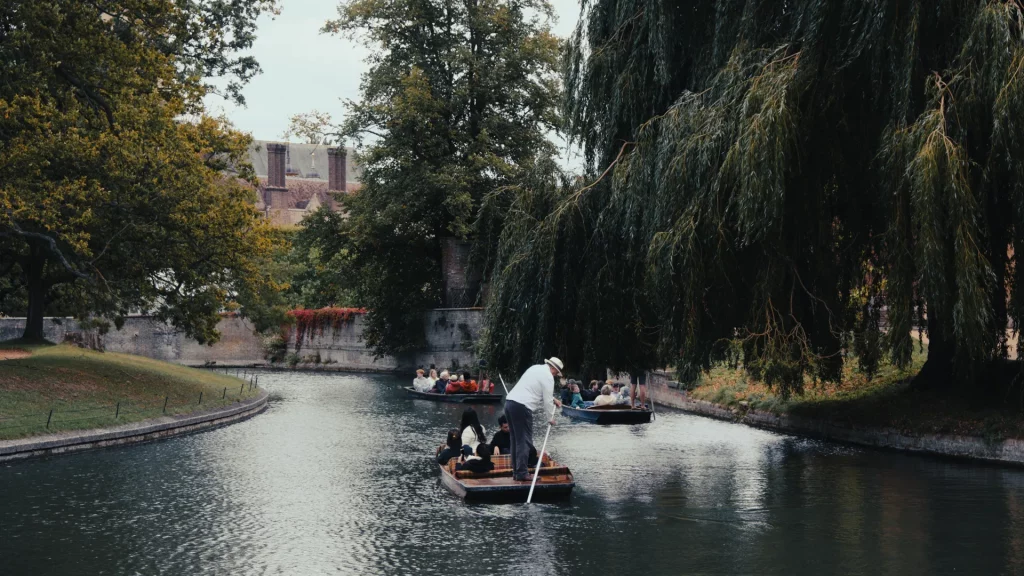
A guided tour is what most visitors do. You book a place on a boat, a guide does the punting, and you spend 45 minutes on the lower river while they navigate The Backs and tell you about the colleges you are passing. It is the straightforward option, and for first-timers it is almost always the right one.
Self-hire is the alternative. You pay for the boat by the hour, take the pole yourself, and go wherever the river takes you — or wherever you manage to steer. Nobody is narrating. Nobody is helping. This is worth flagging upfront: punting looks considerably easier than it is. Keeping a punt moving in a straight line on a quiet stretch of water takes some getting used to; doing it on a busy summer afternoon on the lower river, surrounded by other boats and novices doing the same thing, is a different proposition entirely.
Self-hire makes most sense on the upper river, heading towards Grantchester. Up there the water is calmer, the traffic is lighter, and the whole point is the journey rather than the landmarks. A picnic, a slow afternoon, no particular schedule — that is what self-hire is for.
For the lower river and the college Backs, a guided tour is the better call unless you already know what you are doing.
What self-hire costs
Guided tour prices vary by company and time of day — expect to pay anywhere between £15 and £40 per adult. Cambridge Chauffeur Punts and Trinity are consistently the best value, with fixed, transparent pricing that does not change with demand or season. Other operators adjust their rates based on how busy they are, and touts at the train station will charge whatever they think they can get away with.
Self-hire is charged per boat by the hour rather than per person, which can make it better value for larger groups — though the hourly rate varies by company and season.
Scudamores is worth noting for one specific reason: they are the only operator that allows full 12-person boats to travel up to Grantchester, which makes them the practical choice if you are going upstream with a large group. Trinity and Cambridge Chauffeur Punts are the most popular options for self-hire among people who know the river. CCP allows self-hire boats to be taken upstream, though not the larger 12-person punts.
Shared Tour or Private Punt?
Assuming you are going with a guided tour, there is one more decision to make before you book: shared or private.
A shared tour is the standard option. Your group joins other visitors on a 12-person punt, the guide takes everyone together, and the cost is per person. It is the most straightforward and the best value for solo travellers, couples, or small groups who do not mind sharing the boat. 12-person is the maximum capacity. If you’re going early in the morning or in the evening, then chances are you will have a section to yourself.
A private hire means the boat is yours. You pay for the whole punt regardless of how many people are on it, and the guide focuses entirely on your group. The per-person cost can work out cheaper than a shared tour if you have a large group and pick the right company. Other companies will certainly charge you more for the pleasure.
Private hire tends to make sense in a few specific situations: larger groups who want to stay together, families with young children who want a bit more flexibility, couples celebrating something, proposals, hen parties. If you want the guide to slow down at a particular spot, or you have brought a bottle of something and would rather not share the experience with strangers, private is the way to go.
Some operators also offer add-ons for private hires — champagne on the boat, evening departures & May Ball fireworks tours during June. If any of those are relevant, private hire is the only route. See the May Ball fireworks punting guide for more detail on the fireworks tours specifically, which book out well in advance.
For everything else — a first visit, a day trip, a couple wanting to see the Backs — a shared tour is perfectly good and a fraction of the price.
Which Punt Company Should You Choose?
Since every company covers the same route, the question of which one to book comes down to three things: the guide, the boat, and the price. Of those three, the guide matters most.
The guides
Every operator on the river has guides who are genuinely good at the job. The difference between companies is consistency — how often you are likely to get one.
The information you get varies wildly. On one end, you have got guides who have spent years on the river, know the actual history, and can figure out what your boat is interested in and roll with it. On the other end, summer workers with a script, a list of college names, and about a fortnight of experience.
People who visit Cambridge regularly and go punting more than once often notice this — the same route, the same buildings, and a completely different account of what they are looking at depending on who is standing at the back of the boat.
Here is a pattern worth noticing: the bigger and fancier a company looks, the weaker its guides tend to be. Trinity, Cambridge Chauffeur Punts, and Quayside have guides who have been doing this for years — some for decades. Scudamores is by far the largest operator, which means they hire loads of new staff every summer. That is why their guides are all over the place quality-wise. The same goes for Granta Moring.
It is worth saying clearly: outstanding guides work at every company, and some have moved between several over the years. There is an element of luck involved regardless of where you book. But company choice does shift the odds.
The boats
Most punts seat 12 people across four rows, two benches facing each other, with cushioned seating at floor level. They are wider than they look and generally comfortable enough for the duration.
A few things worth knowing about Granta: their boats are older and narrower than most, with a different seating setup that can feel a bit tight when the tour is full. One row towards the back faces backwards, which means you are basically eye level with the guide’s legs for the whole tour.
Several companies have begun introducing boats with slightly raised seating — closer to a low chair than sitting on the floor — which is worth seeking out if mobility is a consideration. All companies provide blankets in cooler weather and umbrellas if it rains.
The honest steer
Locals tend to book with Trinity or Cambridge Chauffeur Punts. Both are smaller operations with fixed pricing, experienced guides, and no particular interest in volume for its own sake. Visitors arriving at Cambridge station without a booking are most often directed toward Scudamores or the Granta operators — partly by proximity, partly by the kiosks and touts near the station who earn commission on those sales.
Knowing that is most of the battle. The full company-by-company breakdown is in the next section.
Cambridge Punt Companies: The Complete List
Scudamores – The oldest and largest operator on the river, with multiple departure points and a fleet significantly bigger than any other company. Boats are comfortable and guides wear a uniform. As the biggest employer of guides on the Cam, quality varies more than at smaller operations. Pricing is the highest of any operator. A reliable choice if availability or accessibility is the priority; not the best value for money.
Cambridge Chauffeur Punts One of the oldest companies on the river, founded by a former Trinity guide. Wide boats, fixed pricing year-round regardless of season or demand, and a relaxed, unhurried atmosphere. The waiting area by the Mill Pond is one of the more pleasant spots to spend 20 minutes in Cambridge. Tickets are sold in person only — no online booking — which keeps the experience calm and the prices consistent.
Trinity Punting – A small, long-established operation departing from within Trinity College grounds. Guides are among the most experienced on the river, some with decades of service and a connection to the college itself. Fixed pricing, small group sizes. The best option if the quality of the guide matters to you above other considerations.
Granta Moorings – Departing from Granta Moorings, the furthest upstream of the departure points. Their route begins further down the river than other operators and passes through Darwin College before reaching the Backs — a stretch no other company covers. The caveat: guides frequently turn around earlier than they should, sometimes just before one of the best sights on the river.
Quayside
The Quayside operators are a mix of independent companies, most limited to around four boats each. What they lack in scale, they make up for in character — the experienced guides here tend to be the most entertaining and humorous on the river, which makes them ideal if you are punting for a celebration or hen party.
How Much Does Punting Cost in Cambridge?
Prices are all over the place depending on which company you pick, what time of day it is, and how rammed the river is. Budget somewhere between £15 and £40 per adult for a guided tour.
Cambridge Chauffeur Punts and Trinity keep it simple — they charge the same price year-round, no games, no surprises. What you see is what you pay, whether it is January or August. Most other operators play with their prices based on demand. The same tour can cost way more on a Saturday in summer than on a quiet Tuesday in October.
The train station touts? They charge whatever they reckon they can get. They are working on commission, so they have got every reason to push the price up. Book directly through the company’s website or walk to the departure point yourself and you will pretty much always pay less — sometimes significantly less.
Most places offer discounts for students, kids, and seniors. Worth asking when you book
When Is the Best Time to Go Punting?
The honest answer is that timing matters more than most visitors realise — not because the river is ever bad, but because the difference between a quiet morning in April and a Saturday afternoon in August is considerable.
By season
Spring is one of the better times to go. The river is quieter, prices are lower, and the Backs in April and May have a quality to them that summer crowds tend to obscure. May Week in late June brings the college fireworks — the most dramatic time to be on the water, though it requires booking well ahead.
Summer is the peak season in every sense. The best weather, the busiest river, the highest prices, and the fullest boats. Guides running back-to-back tours all day are doing their best, but it shows. If summer is when you are visiting, go early in the day or late in the afternoon.
Autumn is underrated. The Backs in October, with the leaves coming off the trees and fewer people on the water, is genuinely the best time to punt. Prices drop, boats are emptier, and the atmosphere is more relaxed. Worth considering if you have flexibility.
Winter is the quietest time on the river. Several operators reduce their schedules or close entirely, but those who run year-round offer their lowest prices and smallest groups. Cold, obviously, but the colleges look striking in frost and the experience is completely different from a summer tour. Dress properly and it is worth doing.
By time of day
Saturday summer afternoons are the worst time to go punting. The river is at its most congested, the boats are full, and guides are tired. It is still fine — the river is the river — but it is not the experience at its best.
Early morning is underrated and relatively quiet all year round. The water is still, the city hasn’t woken up yet, and the Backs feel perfectly at peace. Late afternoon into early evening is the other good option — emptier boats, softer light on the colleges, and the day beginning to wind down around you.
If you have any flexibility, a weekday morning or evening will give you a noticeably better experience than a weekend afternoon in high summer, usually at a lower price.
Special Occasions and Seasonal Events
May Week fireworks
In late June, the Cambridge colleges hold their May Balls — the annual end-of-year celebrations that are among the most anticipated events in the university calendar. The fireworks displays that close each ball are visible from the river, and several operators run dedicated fireworks punting tours that position you on the water as the displays go up.
It is one of the more unusual things you can do in Cambridge and books out significantly in advance. For everything you need to know about May Ball fireworks punting — dates, operators, what to expect — see the May Ball fireworks punting guide.
Other special occasions
Most operators offer private hire for celebrations of any kind — proposals, anniversaries, hen parties, corporate outings. Evening departures are available through several companies and are worth considering for a more memorable experience than a standard daytime tour. Champagne and other add-ons can usually be arranged for private bookings.
What to Expect on the Day
Arriving and waiting
Most departure points are straightforward to find. Quayside is the busiest and most visible; Trinity departs from within the college grounds; Cambridge Chauffeur Punts operates from the Mill Pond. Exact locations and directions are in the section below.
On quieter days you can walk up, pay, and be on the water within 15 to 30 minutes. In peak summer, particularly on weekends, waiting times can stretch to a couple of hours. If you have a specific time in mind, booking ahead removes the uncertainty.
Boarding
Punts sit low in the water and boarding involves stepping down onto a flat, open deck. The guide will be there to help and will tell you where to sit. It’s not complicated, but flat shoes make it easier and heels make it harder. If you have mobility concerns, it is worth calling the operator ahead of time — some boats now have raised seating that makes the transfer easier, and the guides are generally used to helping passengers who need it.
On the water
The tour takes around 45 minutes. The guide poles from the stern and narrates as you go. The pace is gentle and the boat is stable — rough water is not something to worry about on the Cam. You will pass other boats going in both directions, sometimes they collide with one another.
There are no toilets on the river. This sounds obvious but is worth knowing before you board, particularly if you are going with young children.
Dogs are generally welcome on quieter tours. Prams can usually be brought to the loading area and left there — check with the operator if this matters to you.
Accessibility
Getting into and out of a punt requires stepping down onto a low, moving platform. For most people this is straightforward with a helping hand from the guide. If accessibility is a concern, call the operator before you book.
What to Bring
The essentials are simple.
Wear flat shoes with some grip if you’re planning to go self-hire — the deck of a punt can be slippery, particularly when wet. Avoid heels entirely.
Dress for the weather, and then add a layer. The river is open and the wind on the water feels different from the wind on the street. In summer, sun cream matters more than most people expect — 45 minutes on the water with no shade in direct sun is enough to burn. In winter, dress properly rather than relying on the blankets the operators provide, which are a supplement rather than a substitute.
Bring a camera. The route passes some of the most photographed buildings in the country at close range, from angles you cannot get anywhere else. This is the point of the whole exercise.
Food and drink on board is generally fine on private hire and self-hire. On a shared tour, a bottle of water or a coffee is perfectly reasonable; a full picnic spread is not.
Fair warning: the riverbed is basically a graveyard of iPhones from every generation. Do not hold your phone over the edge for a picture — the river is waiting for it.
Where to Find the Punts in Cambridge
There are four main departure areas along the river, each with a different character.
Quayside is the busiest stretch, centred around the Jesus Green area. Multiple operators have pitches here side by side, touts compete for passing trade, and the atmosphere is commercial. It is the most visible and the easiest to stumble into from the city centre. Several of the larger Quayside operators — Let’s Go Punting, Traditional Punting Company, Rutherford’s — offer online booking and competitive walk-up prices.
Trinity College is quieter and more considered. The departure point is within the college grounds themselves, and the operation is small by design. It is a short walk from the main tourist areas but feels removed from the Quayside bustle.
Mill Pond
Mill Pond sits on the quieter side of the river. Both Cambridge Chauffeur Punts and Scudamores operate from here, but they are completely different experiences. Cambridge Chauffeur Punts has a hidden waiting area right by the water, shaded by willows and dotted with wood carvings. It is tucked away, peaceful, and unhurried — the kind of place where you actually want to be while you are waiting.
Granta Moorings is the furthest upstream and the hardest to reach, a few minutes’ walk beyond the Mill Pond.
If you are arriving at Cambridge station and heading straight to the river, be aware of the kiosks near the station selling punt tickets — see the next section before you buy anything.
How to Avoid Paying Too Much
This is the most useful section on the page, and the one the punt companies would rather you did not read.
Punting in Cambridge has a well-established network of touts and third-party sellers who operate on commission. That commission — which can be as high as 50% — comes directly out of your pocket.
At the train station
The kiosks you will see at Cambridge station sell tickets for legitimate, licensed operators. The tours are real. The problem is the price — touts here work on commission and will charge as much as they can. You will typically pay significantly more than if you booked directly through the operator or walked up to the departure point yourself.
Outside King’s College
It is technically illegal in Cambridge to verbally tout for punt tours on the street. The ban was introduced largely in response to aggressive sales activity near King’s College, which had become a problem. The situation now has a certain irony to it: Scudamores — the largest and most expensive operator on the river, and one of the driving forces behind getting the rules changed — are now the ones selling tours in the same area. If you are approached near King’s College, you are most likely being sold the most expensive option on the river. Walk to the departure points and buy direct.
The rule
If you cannot see the boats from where someone is trying to sell you a ticket, they’re working on commission. walk away.
The pattern worth knowing
Locals heading to the river go directly to Trinity or Cambridge Chauffeur Punts. Visitors arriving by train, without a plan, are the most likely to be intercepted by station kiosks or street touts and directed toward whichever operator pays the best commission. Knowing that before you arrive puts you in a different position.
The cheapest price for any tour is always found by booking directly through the company’s own website, or by walking up to the departure point in person.
How to Book a Punt Tour in Cambridge
There are three ways to book: walk up on the day, book directly online, or book through a third party. The third option is covered in the section above — it is the most expensive route and rarely the right one.
Walk-up
On quieter days — weekday mornings, outside the summer peak, any time in autumn, winter, or early spring — walking up and buying on the spot is perfectly fine. Waiting times are short and prices are consistent.
Book direct online
In peak season — summer weekends, bank holidays, and especially May Week in late June — booking ahead is strongly recommended for the more popular operators. The simplest way is directly through each company’s own website, which also guarantees you the best available price.
Cambridge Chauffeur Punts does not offer online booking — tours can be arranged by phone or email, or by walking up on the day.
When to book ahead
If you are visiting on a summer weekend or bank holiday and have a specific departure time in mind, book at least a day or two ahead. For May Week fireworks tours, book as far in advance as possible — they sell out.
For direct booking links and current availability, see the Cambridge punting tickets and booking guide.
Ready to go punting?
Punting is one of the few tourist experiences left where the best version of it has nothing to do with money or crowds. It is about being on the water with someone who actually knows it, at a time when the river is still yours. Get that right — honest operators, book direct, go early — and you will understand why people have been coming back to this river for centuries.