Trinity College is one of the largest and most historic colleges within the University of Cambridge. Founded by England’s most notorious king almost 500 years ago, it has produced some of the world’s most influential minds. From groundbreaking scientific theories to influential works of literature, Trinity’s legacy in advancing human knowledge is unparalleled.
History of Trinity College
Founded in 1546 by King Henry VIII, Trinity College was created through the merger of King’s Hall and Michaelhouse, two colleges established in the early 14th century. Following Henry’s death a few months after the foundation of the college in 1547, Trinity received vast swathes of land across England, which had formerly belonged to the recently dissolved Catholic monasteries. Owing to its extensive landholdings, Trinity ranks among the wealthiest colleges in the world, with an endowment valued in the billions of pounds.
College Buildings & Walking Guide
Grand courtyards, gothic chapels, and historic libraries showcase some of the finest architecture in Cambridge, blending Tudor, classical, and modern design across the site. Certain areas of the college are open to the public free of charge, while access to other parts requires a ticket.
The Great Gate & Newtons Apple Tree
Originally part of King’s Hall, the Great Gate was completed in 1535 and now serves as the main entrance to Trinity College. Above the large wooden doors there is a row of badges and a statue of King Henry VIII.
Statue of Henry VIII
A statue of Henry VIII sits above the gateway. If you look closely, you will notice a wooden chair leg in his right hand, and an orb in his left.
Often associated with kings and those in power, the orb — known as a globus cruciger — has been a Christian symbol of authority since the Middle Ages. The orb represents the world, while the cross above signifies the Church’s dominion over it. By holding both, the king demonstrates his rule over earthly and spiritual realms alike
The wooden chair leg is the result of a long-running student prank. Henry originally held a sceptre or sword, removed after damage in the 19th century. A student later placed a chair leg in his empty hand, and ever since, replacements mysteriously reappear whenever porters remove them. In 2023, the chair leg was briefly replaced with a gold-painted ceremonial sceptre for King Charles III’s 75th birthday, before the traditional chair leg was restored
Heraldic Shields
Below the statue sits a series of heraldic shields commemorating King Edward III, the founder of King’s Hall, and his sons. The largest shield at the centre represents Edward himself, combining the blue quarters with three gold lions of England and the red quarters with the fleurs-de-lys of France, reflecting his claim to both thrones.
The shields to the left and right represent his sons: Edmund, Duke of York; Lionel, Duke of Clarence; Edward, the Black Prince; John of Gaunt, Duke of Lancaster; and Thomas of Woodstock, Duke of Gloucester. The final shield, for William of Hatfield, is left blank, as he died in infancy before being granted a full coat of arms.
Newton’s Apple Tree
An Apple Tree stands next to the Great Gate as a living link to one of history’s greatest scientific discoveries. This tree is said to be a clone from a cutting, descended from the tree that inspired Newton’s thoughts on gravity.
The Great Court
Passing through the Great Gate, you enter the Great Court, completed in the early 17th century under Master Thomas Nevile. As one of the largest enclosed courtyards in Europe, it presents a harmonious blend of Tudor and Gothic architecture. The court offers an excellent vantage point from which to appreciate Trinity’s scale and symmetry, particularly in summer when the stonework glows in the sunlight.
Great Court Fountain
At the heart of the court stands an ornate fountain, installed around 1600, originally fed by water from the Trinity Conduit Head — a spring to the west of Cambridge acquired by the college after the Dissolution of the Monasteries
Trinity Chapel
Facing into the Great Court, the Chapel is one of the college’s architectural gems. Completed in the mid-16th century during the reigns of Queens Mary I and Elizabeth I, it features a Tudor Gothic design with a fan-vaulted ceiling, tall stained-glass windows, and a peaceful interior. Visitors are welcome to enter when services are not in progress.
College Clock
Next to the Chapel stands King’s Gate, which leads to one of the oldest parts of the college and houses the historic college clock. The oldest surviving element of the clock is its original bell, dating from its first installation in 1610. The bell bears a Latin inscription that translates as: ‘Trinity resounds in unity. 1610. Richard Holdfield made me.’
The clock mechanism was replaced in 1726, and additional chime bells were added. This version became known for its distinctive double striking — first a low Trinity note, then a higher St John’s tone — a feature immortalised by William Wordsworth in The Prelude
Each year, Great Court hosts one of Trinity’s best-known traditions: the Great Court Run. Following their Matriculation Dinner, new students attempt to race around the court immediately after the clock towner begins striking noon. Competitors must complete the approximately 370-metre circuit before the final twenty-fourth strike of the clock. Only a handful of students have ever beaten the clock, and the tradition was famously featured in the film Chariots of Fire.
Nevile’s Court
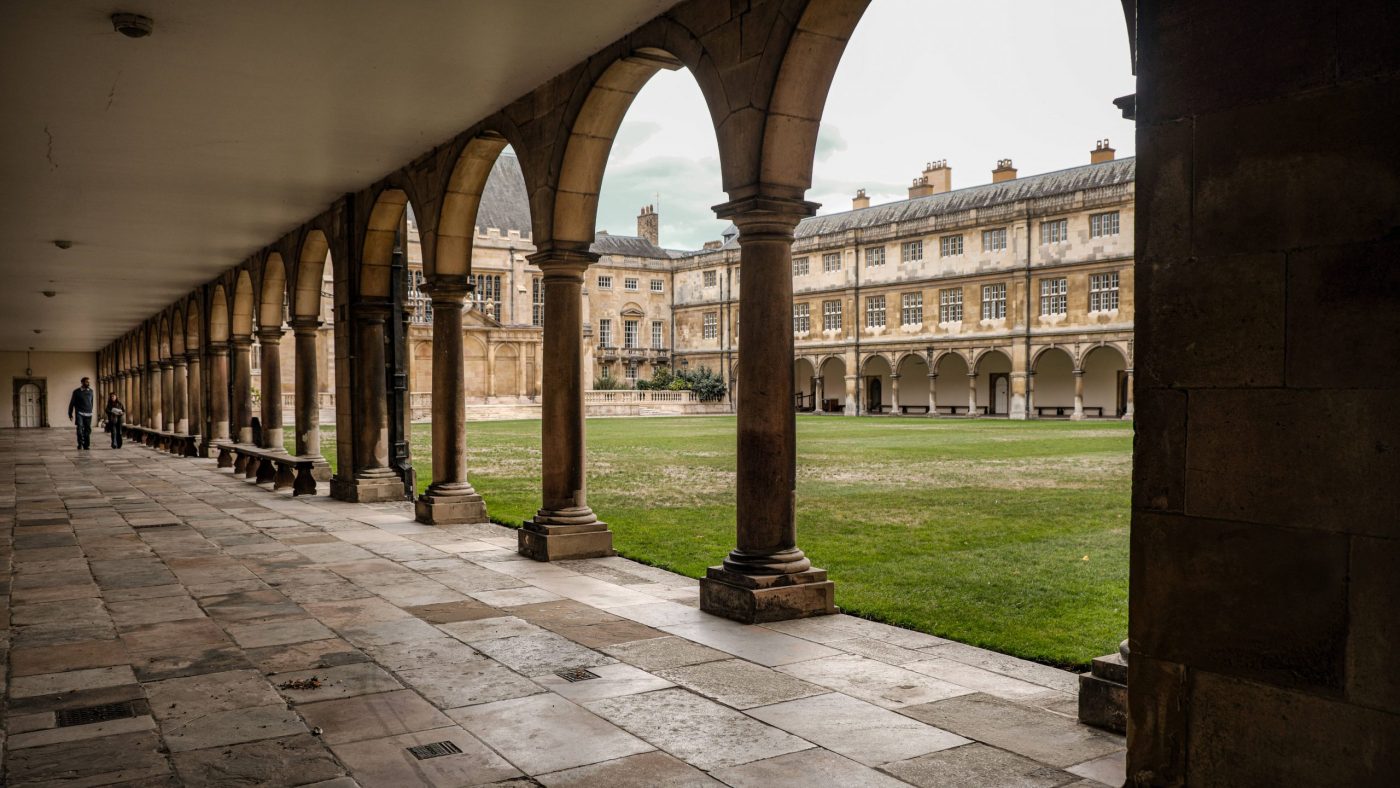
Pass through the southern archway of Great Court to enter Nevile’s Court, a cloistered courtyard leading toward the river, with the Wren Library at its far end. Completed in the early 17th century under Master Thomas Nevile, it was designed as a refined counterpart to Great Court, with symmetrical classical proportions and cloistered walkways creating a quiet, contemplative atmosphere.
New Court
South of Nevile’s Court lies New Court. Built between 1868 and 1870 as part of a major Victorian expansion, it was designed by the architect Sir Arthur Blomfield. Executed in a Victorian Gothic style, it echoes the older architectural language of the college while introducing modern construction techniques. Surrounded by student staircases and residential rooms, New Court features a distinctive circular central lawn rather than a traditional quadrangle.
The River Cam
Passing through New Court leads directly to the college’s back lawns, connecting the historic inner courts with the River Cam and the Wren Library. From here, you can cross the Cam via Trinity Bridge, which offers a view of St John’s New Court in the distance.
Trinity Punts
This part of the college is open to the public via the gate on Garret Hostel Lane, which also provides access to Trinity Punts, where it is possible to join a guided river tour or hire a self-service punt.
The Wren Library
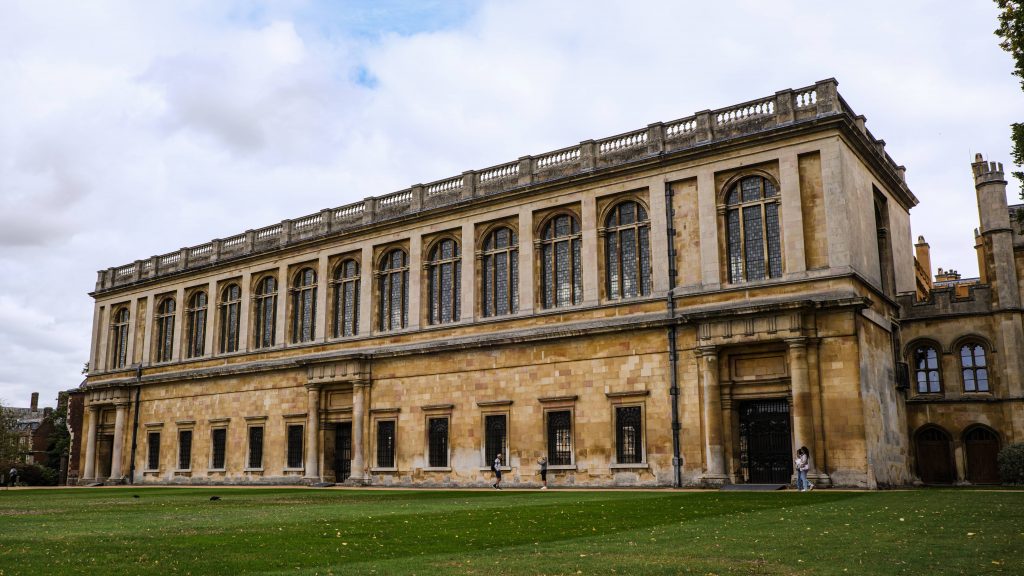
Visitors may also walk along the exterior walls of the Wren Library, which is open to the public during selected hours. Completed in 1695 and named after Sir Christopher Wren, the architect of St Paul’s Cathedral in London, it is one of the finest classical library buildings in England.
Trinity Alumni
In the aftermath of the English Reformation, Trinity became a destination for the education of future political and ecclesiastical leaders, and it remains widely regarded as the most prestigious college within the university.
To date, members of Trinity College have won 34 Nobel Prizes (more than the total of all 36 colleges at Oxford University). Many of the world’s most influential thinkers, who have shaped modern life, were educated at Trinity. Most notable among them are:
Sir Isaac Newton
Graduated in 1665 in mathematics, later formulating the laws of motion and universal gravitation, laying the foundations of classical physics.
Lord Byron
Graduated in 1808 in classics, becoming one of the leading figures of Romantic poetry.
Lord Tennyson
studied at Trinity College from 1827, later becoming Poet Laureate and one of the most celebrated poets of the Victorian era.
James Clerk Maxwell
Gaduated in 1854 in mathematics, formulating the equations of electromagnetism that unified electricity, magnetism, and light.
J. J. Thomson
Graduated in 1880 in mathematics and physics, later discovering the electron, transforming atomic science.
Bertrand Russell
Graduated in 1893 in mathematics, later pioneering analytic philosophy and modern logic.
Ernest Rutherford
Studied physics at Trinity College from 1895, later becoming the father of nuclear physics through his discovery of the atomic nucleus.
A. A. Milne
Graduated in 1903 in mathematics, later achieving global fame as the creator of Winnie-the-Pooh.
Jawaharlal Nehru
Graduated in 1910 in the natural sciences, later becoming India’s first Prime Minister and a central figure in the independence movement.
Venki Ramakrishnan
Fellow of Trinity College, awarded the Nobel Prize in Chemistry for revealing the structure of the ribosome, fundamental to understanding protein synthesis.
King Charles III
Graduated in 1970, studying archaeology, anthropology, and history, later becoming King of the United Kingdom and a prominent advocate for environmental conservation.
Trinity College Visitor Information
Key information in preparation for your visit to Trinity College.
Open Hours
Trinity College and its chapel are generally open to tourists daily from 10:00 AM to 4:30 PM (last entry around 3:30 PM in winter months
The Wren Library has special visiting hours: it is open to the public for free from 12:00–2:00 PM on weekdays and 10:30 AM–12:30 PM on Saturdays (during Cambridge University term time).
Tours and Ticket Cost
Visitors may explore Trinity College either by joining a guided tour organised by the college or by purchasing an individual visitor ticket. Guided tours operate twice daily at 10am and 2pm, led by the college porters.
Adult tickets cost £5, and children under 12 enter free. Individual visitor tickets are also available for purchase.
Getting There
Trinity College is located on Trinity Street in central Cambridge (CB2 1TQ), very close to the city center and market square. It’s easy to reach on foot or by local transport.
Trinity Evensong
Evensong (evening prayer service with music) in Trinity Chapel usually takes place several times a week during term (often around 6pm) and is open to the public for free. Listening to the choir’s voices soar in the historic chapel is truly memorable, even if you are not religious. The chapel’s acoustics also make it a popular venue for concerts – the college’s music society and chapel choir organise regular concerts and organ recitals, often advertised on the Trinity website or outside the chapel.
Notice to Visitors
Remember that Trinity is a working college, home to students and faculty. Keep noise to a minimum, especially near the library or study areas. Certain areas are marked “Private” – these are off-limits to visitors and should be respected. A few specific rules: do not walk on the grass lawns (only Fellows and their guests may do so – it’s a long-standing Cambridge tradition.
The Porters at the Great Gate (identifiable by their bowler hats) are friendly and can answer questions – just approach them if you need help or have an inquiry during your visit.
Reasons To Visit
Walking through Trinity’s historic courts, surrounded by portraits and busts of influential alumni can be deeply inspiring.