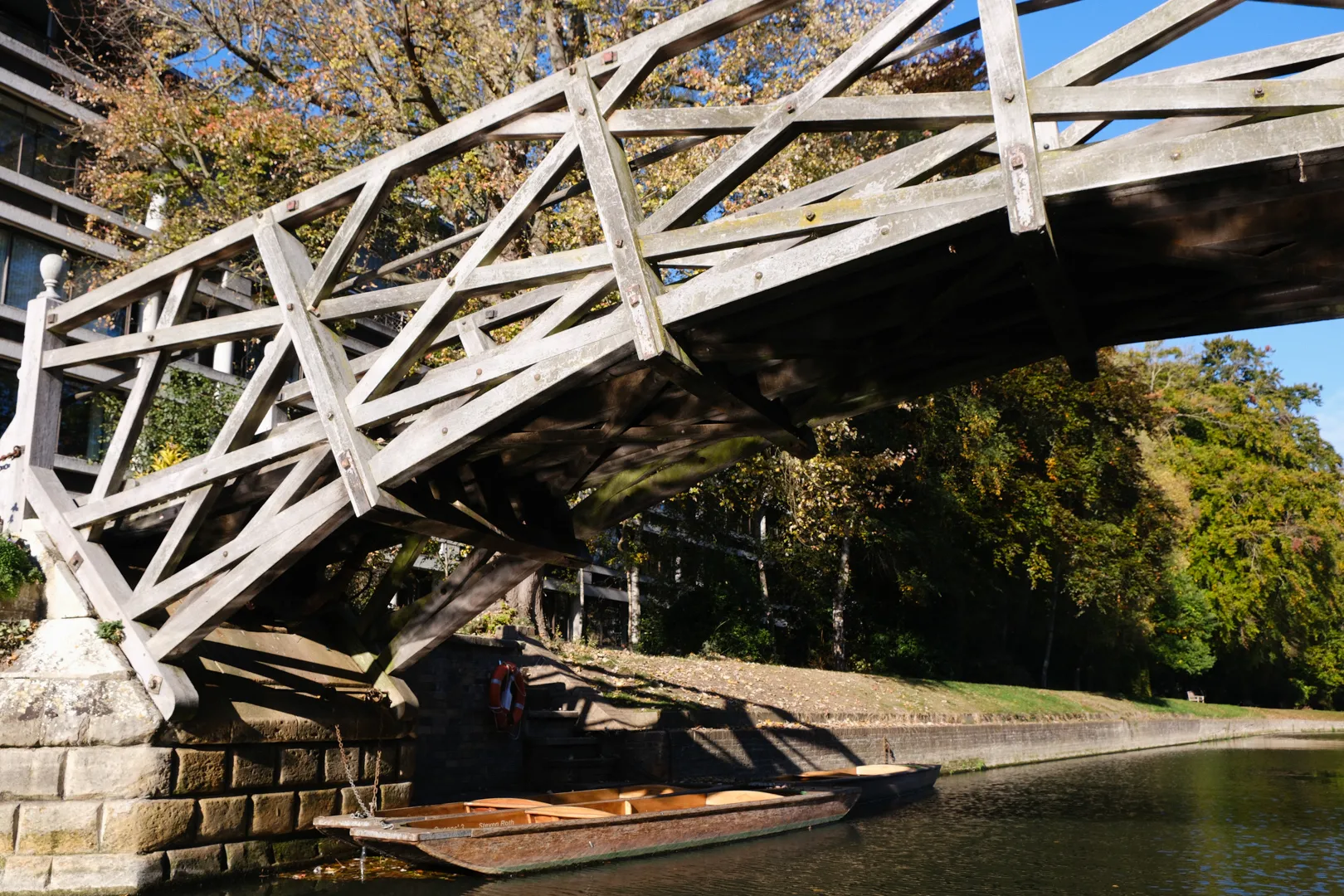
Queens’ College was founded twice, by two queens on opposing sides of the Wars of the Roses. It occupies both banks of the River Cam in central Cambridge, joined by the Mathematical Bridge — the most argued-over structure in the city, and the subject of a story that almost every visitor arrives already believing. The college has stood here since 1448, and much of what people come to see was built within its first fifty years.
History of Queens’ College
The college began as someone else’s project. Andrew Dokett, principal of St Bernard’s Hostel and rector of St Botolph’s, obtained a charter from Henry VI on 3 December 1446 to found St Bernard’s College. That charter was revoked less than a year later, and on 21 August 1447 Dokett secured a second one for a larger site nearby.
Margaret of Anjou, Henry VI’s queen, then took the foundation over. Henry granted her the lands on 30 March 1448, and her own charter of 15 April 1448 established the Queen’s College of St Margaret and St Bernard. The foundation stone was laid by Sir John Wenlock, her chamberlain, standing in for her.
The second queen came from the opposing side of a civil war. In 1465, with the House of York in power, Elizabeth Woodville — queen consort of Edward IV — became the college’s second foundress, and gave Queens’ its first statutes in 1475. Richard, Duke of Gloucester, endowed four fellowships in 1477 and gave again in 1484 as Richard III, alongside his queen, Anne Neville. Henry VII stripped away every one of those endowments in 1485.
Why the apostrophe sits after the s
The usual explanation is that Queens’ takes a plural possessive because two queens founded it. The college’s own historians are blunt about this: the story is mostly wrong.
For the first two centuries the name carried no apostrophe at all, written “Quenes college” in 1592 and “Queens Colledge” in Thomas Fuller’s history of 1655. The earliest apostrophe on record appears in 1660, in John Smith’s Select Discourses, and it is singular — Queen’s. That singular form held for roughly one hundred and sixty years. G. C. Gorham used the plural in 1823, the Cambridge University Calendar adopted it in 1831, and it became standard over that decade. The formal corporate title keeps both, running “The Queen’s College of St Margaret and St Bernard, commonly called Queens’ College”.
Buildings and Walking Guide
Queens’ is compact, and the route through it runs east to west, from the older courts to the far bank of the Cam. Visitors enter and leave through the Visitors’ Gate on Queens’ Lane.
Old Court
Old Court is the oldest part of the college. It was built between 1448 and 1451 — the first section finished in 1448, the rest, including B and C staircases, the kitchens and the hall, in 1449 and 1450. Henry VI donated £200 towards the work in 1449. The external load-bearing walls were made of clunch, a local soft chalk, with a thin skin of hard red brick, and the internal fabric is timber-framed. The strong presumption is that Reginald Ely, master mason on the early stages of King’s College nearby, was the mason responsible. The sundial was erected in 1642, the same year the college sent all its silver to help the king. Battlements were added in 1819 and removed from the east and south sides again in 1926.
Walnut Tree Court and the chapel
Walnut Tree Court stands on ground that belonged to the Carmelite friars until the dissolution. The Carmelites surrendered their monastery site in 1538 and the college completed the purchase in 1544. The Walnut Tree Building went up between 1616 and 1618; a fire in 1777 destroyed its upper floors, rebuilt between 1778 and 1782.
The chapel facing the court is Victorian, designed by G. F. Bodley and built between 1888 and 1891. Its predecessor fared badly: in 1643 William Dowsing, the parliamentary iconoclast employed to strip churches of their imagery, worked his way through it. The present chapel was struck by lightning in 1928.
Cloister Court and the President’s Lodge
Cloister Court sits between Old Court and the river. The riverside buildings that now form the President’s Lodge were put up around 1460, and it’s the oldest building on the River Cam and the second oldest at Queens’, though its exact date isn’t recorded in any surviving contemporary document — so “around 1460” is the honest phrasing rather than a fixed date. The cloister walkways were added in the 1490s, which is what turned the space into a court, and above them runs the Long Gallery, probably built between 1595 and 1602.
The court floods. In February 1795 the water reportedly stood waist-deep in the cloisters. In 2014 an underground tunnel was rediscovered beneath it.
The Mathematical Bridge
The Mathematical Bridge crosses the Cam between Cloister Court and the far bank, and it is why most visitors come. William Etheridge designed it in 1748 and James Essex the Younger built it in 1749. It measures 50 feet 8 inches, or 15.44 metres, and spans the river using timbers much shorter than the crossing, arranged as tangents to a circle of 32 feet radius. That geometry is what makes a structure of straight beams read as an arch.
The original was oak. It was repaired in 1866 and 1867, when the cross-beams were replaced and the stepped decking was changed to a slope, at a cost of £348 7s. In 1905 it was rebuilt completely, in teak, by William Sindall, for a final payment of £207 6s 6d.
It has no official name. College records call it Essex’s Bridge, after its builder. The name everyone uses first appears in print in 1803, in A Guide through the University of Cambridge, in a footnote observing that it was usually known as the Mathematical Bridge.
Three stories attach to the bridge, and the college’s own historians dismiss all three.
The first is that Isaac Newton designed it. Newton died in 1727, twenty-two years before the bridge was built, and no record places him anywhere near it. The story first appeared in print in 1897, which makes the myth younger than the bridge standing today.
The second is that the bridge originally held together without fixings, and that bolts were added only later to repair a mistake. It never did hold together without them. The joints carried fastenings from the start, and without them the side trusses would be liable to twist sideways or spring apart. Before 1905 those fastenings were visible only on the outer faces, which is the likeliest source of the story. The 1905 rebuild used coach-bolts visible from both sides.
The third is that students once took the bridge apart and could not put it back together. There is no record of it happening.
Newton did have dealings with Queens’, as it happens, though not with the bridge. In 1677 the college asked him to assess how much daylight a proposed new building at St Catharine’s would block. Charles II wrote in support of the request.
West of the river
The land west of the Cam was bought from the town in October 1475, and the college has been extending across it since. Gardens and walks were laid out on what was then an island in 1539, and the Fellows’ Garden — now Erasmus Lawn — followed in 1553. Erasmus’s Walk was built jointly with King’s College in 1684. The island stopped being an island in 1841, when the ditch running parallel to Silver Street was filled in.
Two modern buildings stand here. The Erasmus Building, designed by Sir Basil Spence, was erected in 1959 and 1960 and formally opened by the Queen Mother on 5 June 1961. Cripps Court, by Powell, Moya & Partners, arrived in three phases: the first occupied in October 1974, the second completed in 1983, the third in 1989, with a fourth floor added in 2006 and 2007.
Notable Figures
Erasmus — Humanist scholar — in residence at Queens’ in 1506 and again from 1510 to 1515. The Erasmus Building, Erasmus Lawn and Erasmus’s Walk all carry his name.
John Michell — Natural philosopher — admitted on 17 June 1742, graduated BA as fourth wrangler in 1748, and elected a fellow on 30 March 1749. In a paper of 1783 he proposed that a star of sufficient mass could stop its own light escaping, describing what is now called a black hole. He also stated the inverse-square law of magnetism in 1750, was the first to describe earthquakes correctly as waves travelling through an elastic earth, and built the torsion balance later used by Henry Cavendish to weigh the Earth.
Alexander Crummell — Priest and writer — admitted on 22 June 1849 and graduated BA in 1853, and possibly the first Black graduate of Cambridge. When a heckler interrupted his degree ceremony, E. W. Benson, later Archbishop of Canterbury, rallied the room to cheer for him instead. He spent years afterwards in Liberia and founded the American Negro Academy in 1897.
John Hall — Physician — matriculated in Michaelmas term 1589 and graduated BA in 1593. He practised near Stratford-upon-Avon and married Shakespeare’s daughter Susanna on 5 June 1607.
T. H. White — Author — entered Queens’ in 1925 to read English, and graduated with first-class honours (sources give the year as 1928 or 1929). He wrote The Once and Future King, the Arthurian cycle that begins with The Sword in the Stone.
Demis Hassabis — Computer scientist — matriculated in 1994, graduated in 1997 with a double first in computer science, and went on to co-found DeepMind. In 2024 he became the college’s first Nobel laureate, for his work on AI models of protein structure.
Emily Maitlis and Stephen Fry also studied at Queens’ (English, in both cases) — Maitlis went on to present BBC Newsnight; Fry became an actor and writer.
Visiting Queens’ College
Opening hours
The College is open to visitors year-round, 10:00–16:00, except during the examination period, certain ceremonial days, and the Christmas holidays. Closure dates are published annually and change each year — worth double-checking before a visit, since exam-period closures in particular can run for weeks.
Tickets
Entry costs £5.00 per visitor, and children under 12 accompanied by an adult go free. Up to six people can enter for a self-guided tour; larger groups (six or more) must be accompanied by a Cambridge Blue Badge Guide, also at £5 per person. Old Hall and the Chapel are normally open but subject to the college’s events programme, and all cloister areas and walkways are open; the President’s Lodge, Old Library, War Memorial Library, Cripps Dining Hall, and all rooms and staircases are not open to visitors.
Seeing the Mathematical Bridge without a ticket
The bridge can be seen without paying. Silver Street bridge, a few steps from the college, gives a clear side view of the whole structure and of the geometry that holds it up. A punt passing underneath gives the closest view, which is why punting tours make a point of it.
This is worth knowing for anyone with limited time: the most photographed thing at Queens’ is visible from a public road at no cost. What a ticket buys is Old Court, the cloisters, and crossing the bridge rather than looking at it.
Getting there
Queens’ College stands on Silver Street in central Cambridge, occupying both banks of the Cam. The postcode is CB3 9ET.
Accessibility
Wheelchair access is available through the Porters’ Lodge at all times. Some surfaces are uneven and can be slippery in wet weather, there are steps on the route around the site, and care is needed near the river. Queens’ publishes a full disability access guide for anyone with specific access needs.
Is Queens’ worth visiting
Queens’ charges for entry to a college whose most famous feature can be seen for nothing from the road outside. What the ticket buys is the quieter, older part — a court finished in 1451, a cloister that has flooded to waist height, and the crossing itself. For anyone with a day in Cambridge and an interest in how these places were actually built, and in how confidently the wrong story gets told about them, that is a fair trade.