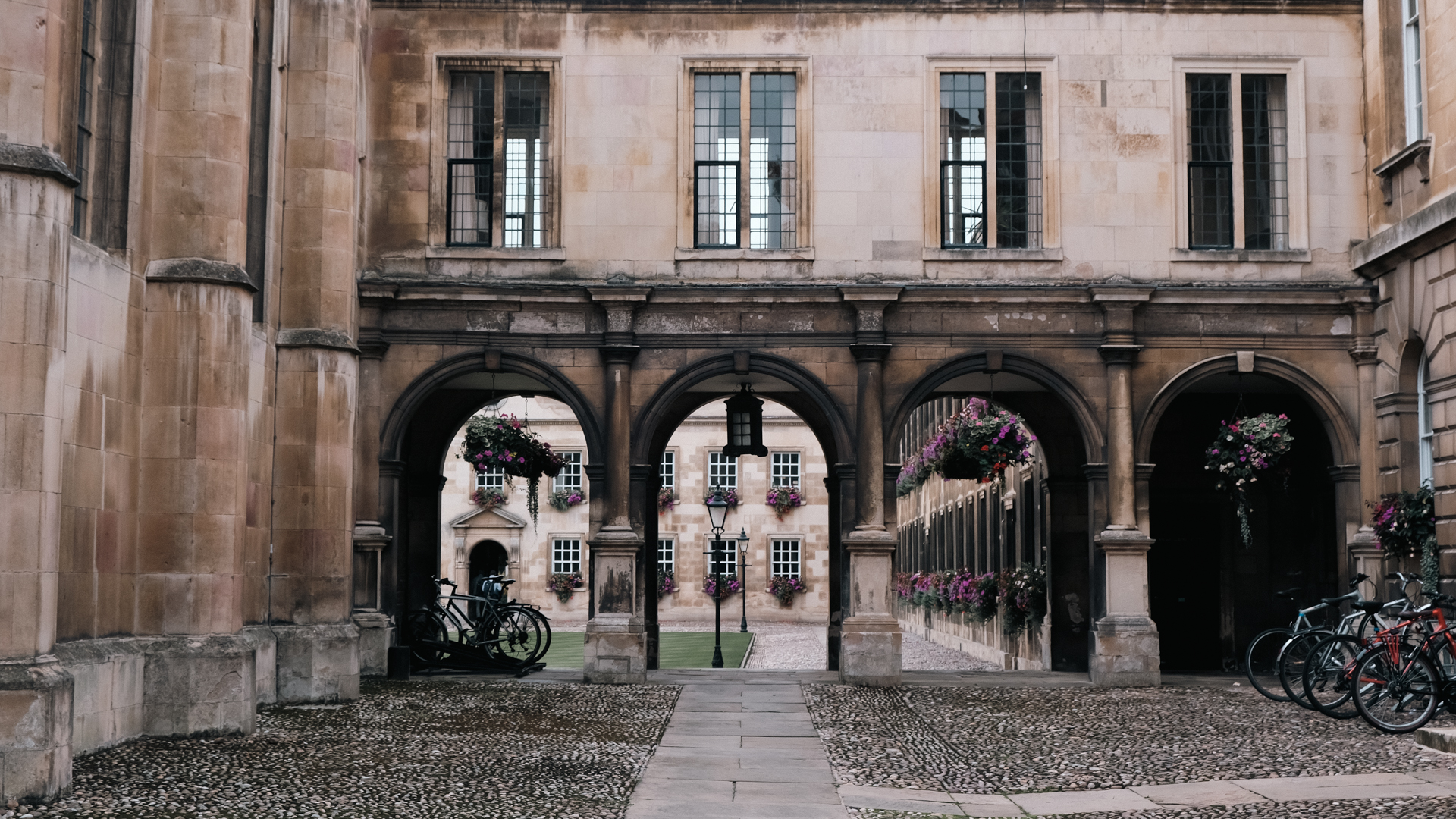
Peterhouse is Cambridge’s oldest surviving college, founded in 1284 by Hugo de Balsham, Bishop of Ely. As the first of the university’s colleges to be formally endowed for a community of scholars, Peterhouse set the architectural and institutional model that would define Cambridge for centuries to come. The college occupies a compact, historically layered site south of the city centre, with buildings spanning from the medieval period to the twentieth century.
History of Peterhouse
Peterhouse was founded in 1284, making it the earliest of Cambridge’s colleges by formal endowment — though University Hall (later Clare College) was established around the same time. Hugo de Balsham, a bishop and scholar, established the college to support a small community of scholars, initially called the “House of the Scholars of the Bishop of Ely”. The endowment made it distinct from earlier informal associations of students.
The college survived the Reformation and the dissolution of monastic communities that threatened many Cambridge institutions in the sixteenth century, though like all colleges it underwent significant religious and academic upheaval. By the seventeenth century, Peterhouse had established itself as a leading centre for mathematics and natural philosophy, producing scholars of considerable influence.
Expansion came gradually. Much of the core college was rebuilt or substantially modified between the sixteenth and eighteenth centuries, with the nineteenth and twentieth centuries bringing further additions as the college grew in size and scope. Despite these changes, Peterhouse retains a strong sense of historical coherence, with medieval, Tudor, Georgian and modern buildings in close proximity.
Peterhouse Buildings and Walking Guide
The Gatehouse stands at the entrance on Trumpington Street, a fourteenth-century structure that has survived largely intact. This modest gate marks the entrance to one of the most historically significant college sites in Cambridge.
The Hall, rebuilt in 1632, is one of the college’s largest communal spaces. Like many college halls of this period, it reflects both practical needs (feeding and gathering the college community) and architectural ambition. The hall remains in use for formal dinners and gatherings.
The Chapel, completed in 1632, replaced an earlier medieval structure. The interior is noted for its seventeenth-century furnishings and the quality of light from its windows. As with many Cambridge chapels, Evensong services are held regularly and are open to visitors.
Scholars’ Court represents the medieval and early modern heart of the college. The courtyard is surrounded by buildings dating from different periods, creating a visual timeline of architectural styles from the fourteenth century onward. Walking through Scholars’ Court, the progression from medieval to later work becomes visible in the stonework, window patterns and roof lines.
The Library, originally housed in a medieval undercroft, was significantly expanded in the eighteenth century. Like most college libraries, it combines historical architectural spaces with modern additions necessary for a working academic library.
Grange Farm buildings, situated south of the main college, represent land held by Peterhouse for centuries as part of its endowment. These agricultural structures, now largely residential, reflect the college’s historical role as a landed institution.
Notable Fellows and Alumni of Peterhouse
Andrew Wiles — Studied at Peterhouse and later became renowned for his proof of Fermat’s Last Theorem, one of mathematics’ most famous unsolved problems for over three centuries.
M.R. James — The celebrated mediaeval scholar and ghost story writer spent much of his academic career at Peterhouse, serving as Provost and producing influential works on manuscript culture.
Lord Kelvin (William Thomson) — The physicist and engineer studied at Cambridge; his work on thermodynamics and electromagnetism established fundamental principles in physics.
Bertrand Russell — The philosopher and logician, though better associated with Trinity College, had significant connections to Cambridge mathematics circles that included Peterhouse scholars.
Visiting Peterhouse, Cambridge
Location
Peterhouse is located on Trumpington Street, south of the Cambridge city centre, approximately a ten-minute walk from King’s College and the Market Square. The college is not immediately adjacent to The Backs, but lies at the quieter, residential end of Cambridge’s college district.
Access
Like most Cambridge colleges, Peterhouse maintains restricted access to its courtyards and buildings. Visitors are generally not permitted to enter college buildings, though the gatehouse and exterior of the main college buildings can be viewed from the street. The college chapel may be open for Evensong services — confirm times in advance.
Getting there
From Cambridge city centre, walk south down Trumpington Street for approximately twelve minutes. The college entrance is clearly marked on the street. Parking in this area is limited and subject to permit restrictions; walking or cycling is recommended.
Notice to visitors
Peterhouse is an active academic community. Keep noise to a minimum, do not walk on college grass, and respect that residential and teaching spaces are not open to casual visitors. Photography is at the discretion of the college — ask before photographing people or sensitive areas.
At approximately 730 years old, Peterhouse holds a claim to be the oldest Cambridge college by formal endowment, a distinction that carries both historical weight and practical implications. The college’s compact medieval core, surrounded by later additions, offers visitors a concentrated view of how English academic architecture evolved over seven centuries. Though much of the college remains closed to tourists — a consequence of its continuing role as a teaching institution — the exterior and the college chapel provide insight into one of Cambridge’s most historically significant communities. For those interested in the physical evolution of Cambridge’s colleges and the intersection of medieval ecclesiastical foundation with later academic expansion, Peterhouse rewards a brief visit to its gatehouse and south-facing façade on Trumpington Street.