-
Parker's Piece
Key Information
In the heart of Cambridge, opposite the famous market square and nestled among centuries-old colleges, stands Great St Mary’s Church — a striking landmark known for its beautiful architecture and panoramic tower views. Whether you’re seeking history, scenery, or a peaceful spot to reflect, this church is a must-see stop on any Cambridge itinerary.
Price
Free
Main Feature: The Tower and Views of Cambridge
The church’s most popular feature is its 114-step tower, which offers breathtaking 360-degree views over Cambridge. From the top, visitors can spot landmarks such as King’s College Chapel, the River Cam, and the university’s historic buildings. It’s especially captivating at sunset or in the spring when the city is in full bloom.
History and General Information
Great St Mary’s has been the University Church since 1209, making it a spiritual and ceremonial hub of Cambridge for over 800 years. Rebuilt in the late 15th and early 16th centuries in the Perpendicular Gothic style, the church has hosted countless university sermons, debates, and events. Its bells, rung regularly, are some of the heaviest and most famous in the area. Inside, you’ll find grand stained-glass windows, a fine organ, and peaceful spaces for contemplation.
Opening Times and Getting Here
Great St Mary’s Church is typically open daily to visitors, with the tower accessible from late morning to late afternoon. Opening hours may vary with services or weather, so it’s best to check the church’s website before visiting.
Located in the city centre, it’s just a 10-minute walk from Cambridge train station or easily reachable by bus, bike, or on foot from anywhere in town.
What’s Nearby
Surrounded by colleges and the bustling market square, the church is at the core of Cambridge sightseeing. Nearby, you can visit King’s College Chapel, take a punting tour on the River Cam, or explore the Fitzwilliam Museum. Quaint cafés and bookshops also line the surrounding streets — perfect for a relaxed post-visit stroll.
In Summary
Great St Mary’s Church is more than a place of worship — it’s a gateway to the story of Cambridge itself. With its panoramic tower, historical importance, and central location, it’s a must-visit destination that offers both inspiration and insight into the heart of this iconic university town.
Contact
-
Email office@gsm.cam.ac.uk
-
Phone Number +44 (0)1223 741716
Open Hours
-
Monday - Satuday 10:00 am - 5:30 pm
-
Sunday 12:00 pm - 5:00 pm
Directions
The University Church
-
Senate House Hill
-
Cambridge
-
CB2 3PQ
More Attractions
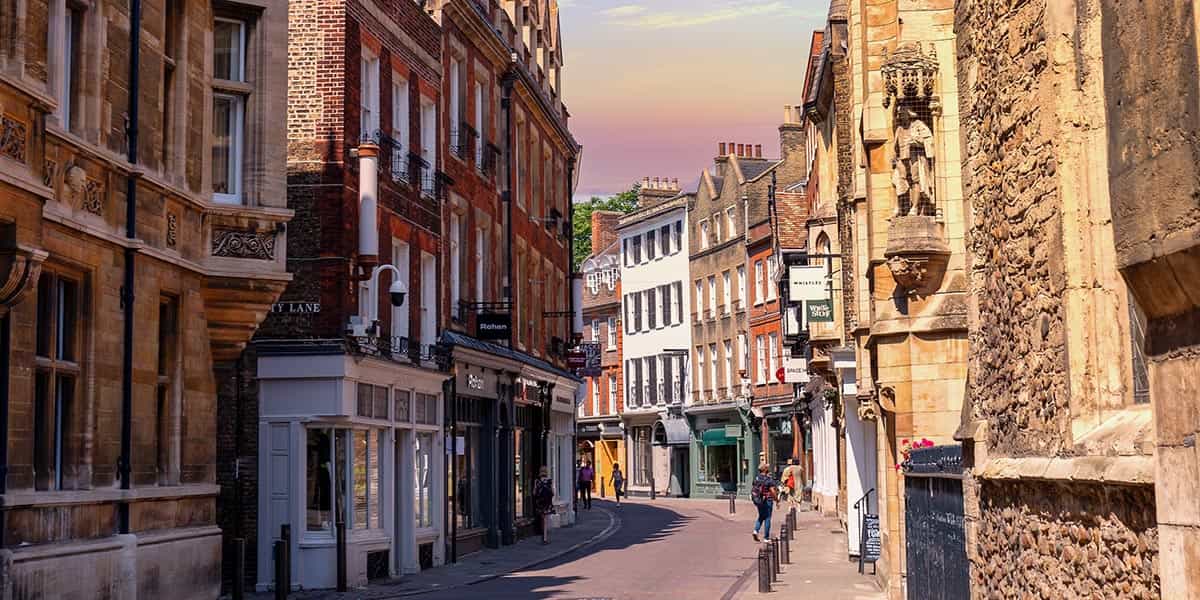
-
Market Square
A Crusader Church in the Heart of Cambridge
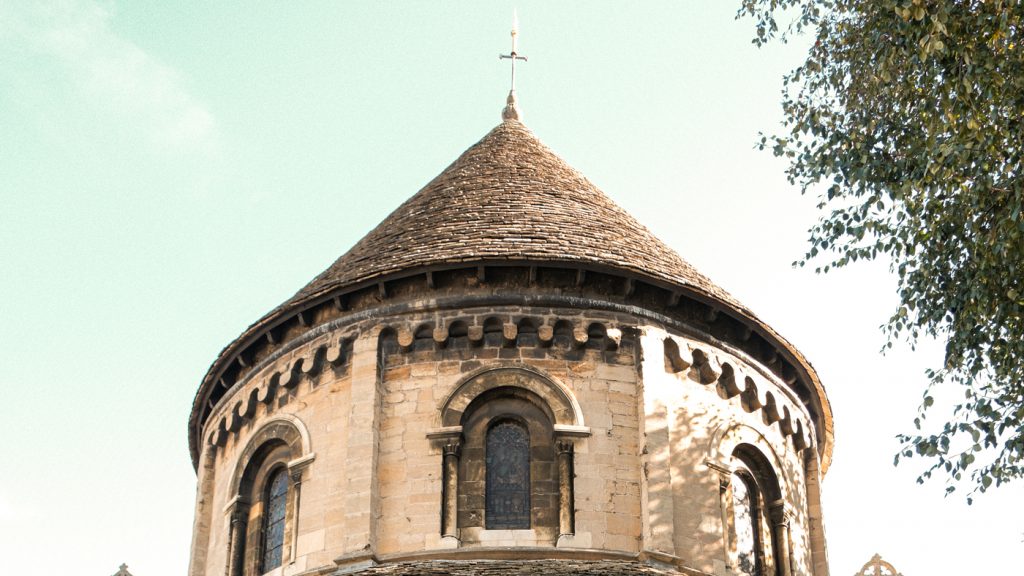
The Round Church sits at a busy junction just outside central Cambridge, and it’s easy to miss how old it is until you stop and look. Founded between 1114 and 1131 by the Brotherhood of the Holy Sepulchre, it was built by returning Norman crusaders and modeled on the Church of the Holy Sepulchre in Jerusalem, believed to stand over the tomb of Jesus. The circular layout comes from that original 4th-century design.
From the pavement, the building’s shape is immediately distinctive. The stone exterior is pale and weathered, with surfaces worn smooth by centuries of exposure. Traffic moves constantly around it, but the church itself feels self-contained — a medieval island in a modern road system.
Reading the Norman Architecture
This is one of the best-preserved Norman buildings in England, and many details are still easy to spot without specialist knowledge. The entrance arch shows classic zigzag carving, and above the doorway you can see dogtooth ornament — patterns influenced by designs crusaders encountered in the Middle East.
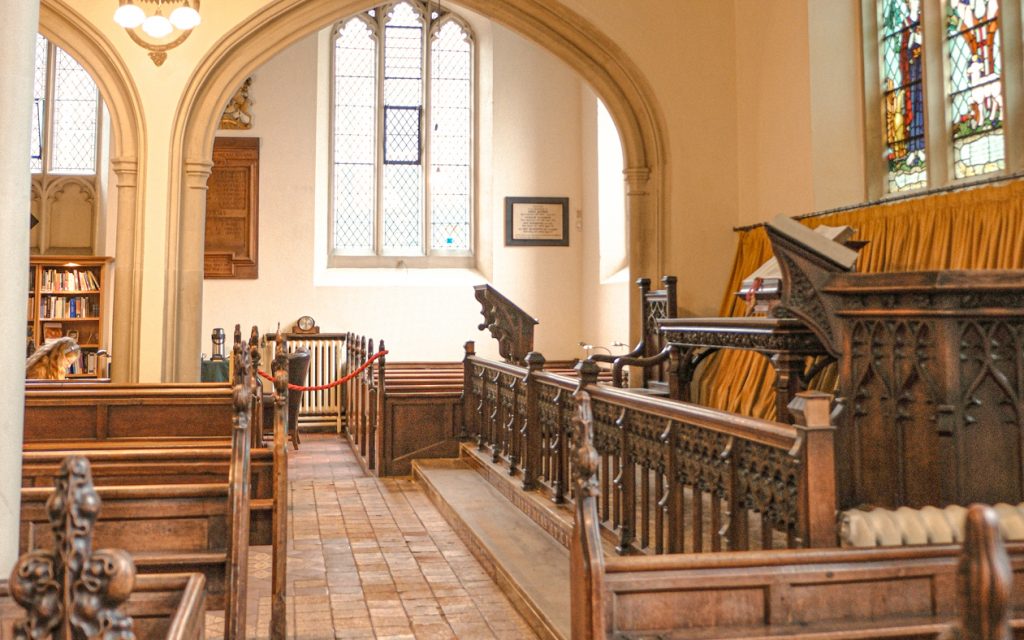
Inside, the temperature drops noticeably, even in summer. The thick walls hold cool air, and sound carries softly in the circular space. The heavy columns and rounded arches are practical Norman engineering: solid, load-bearing, and built to last. Natural light enters unevenly through the upper windows, creating alternating bright and shaded areas as you move around the interior.
A Medieval Boundary Marker
In medieval Cambridge this church marked the northern edge of town. Travelers arriving or leaving would stop here to give thanks. Today it still sits on a transitional edge — close to shops and cafés, but slightly removed from the main tourist flow.
The building was originally maintained by monks from St John’s Hospital before becoming a parish church, tying it directly to Cambridge’s early medical and charitable history.
Collapse and Victorian Restoration
A tower added in the 15th century collapsed in 1841 after being extended too heavily in Gothic style. Victorian restoration aimed to recover the earlier medieval appearance, guided in part by the Cambridge Camden Society.
Some decorative features you see today — including carved heads looking down from above — are Victorian additions rather than Norman originals. The stained glass largely dates from restoration between 1841 and 1843 and gives the interior a warmer tone than bare stone alone would provide.
Civil War Damage and Rare Survivals
Much of the medieval decoration was destroyed during the English Civil War. On 3 January 1644, Parliamentarian commander William Dowsing ordered the removal of fourteen windows and sculptures. Only four upper-story windows from around 1400 survived.
Look up at the timber roof: wooden angels carved in the 15th century remain in place. These are rare survivals from a period when religious imagery was widely destroyed. They hold musical instruments — a lute and a flute — and are easiest to see from the center of the nave.
Wartime Damage and Post-War Repairs
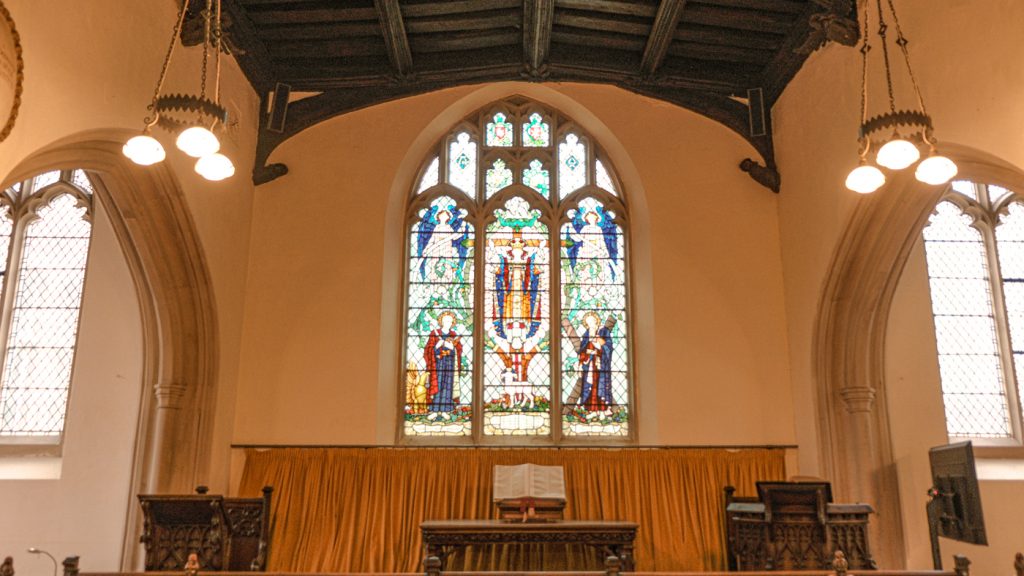
The church was damaged again in a 1942 air raid that hit 127 Cambridge buildings. The east window, installed in 1946, contains dense biblical symbolism and stands out for its color intensity when sunlight passes through.
Underfoot are Victorian encaustic tiles, among the first commercially produced in Britain. The repeating symbols of the four Gospels — man, lion, bull, eagle — are still clear despite wear from foot traffic.
Royal Connections and Small Details to Notice
Two royal coats of arms commemorate Prince Albert and Queen Victoria’s reopening of the church in 1843. A worn tile marks their earlier 1840 visit — easy to overlook unless pointed out by staff or signage.
Outside, fountain-pen-shaped bollards reference the literacy legacy of Samuel Pepys. They’re a small modern addition that contrasts with the medieval structure and are a quick photo stop.
Visiting Information
The Round Church is the second most visited site in Cambridge after King’s College Chapel and now functions as a heritage centre with exhibitions on England’s religious history. Expect a quiet interior even when busy; the circular layout disperses sound, so conversations remain low and echo lightly.
Plan for about 30–45 minutes to explore properly, including displays. The church is compact, so it works well as a short stop between larger Cambridge attractions, but the architectural details reward slow observation. Even on a crowded day outside, the interior remains calm and cool — a practical refuge as well as a historical site.
Opening Times
- Tuesday: 1:30 PM – 4:00 PM (last entry at 3:45 PM)
- Wednesday to Saturday: 10:00 AM – 5:00 PM (last entry at 4:45 PM)
- Sunday and Monday: Closed (except for occasional events)
Opening times may vary on holidays or for special events. It’s advisable to check their official website before your visit.
Directions
You can reach the church easily from central Cambridge on foot. The nearest car park is Park Street Car Park, and several bus routes serve the area. It’s about a 15-minute walk from Cambridge train station.
Address : The Round Church, Bridge Street, Cambridge, CB2 1UB
[post_title] => The Round Church [post_excerpt] => The Round Church, officially known as the Church of the Holy Sepulchre, is one of the oldest buildings in Cambridge, dating back to 1130. It is renowned for its unique round shape, inspired by the Church of the Holy Sepulchre in Jerusalem. [post_status] => publish [comment_status] => closed [ping_status] => closed [post_password] => [post_name] => round-church [to_ping] => [pinged] => [post_modified] => 2026-02-08 17:07:02 [post_modified_gmt] => 2026-02-08 17:07:02 [post_content_filtered] => [post_parent] => 0 [guid] => http://remember-cambridge.local/?post_type=attraction&p=619 [menu_order] => 0 [post_type] => attraction [post_mime_type] => [comment_count] => 0 [filter] => raw ) 1 -->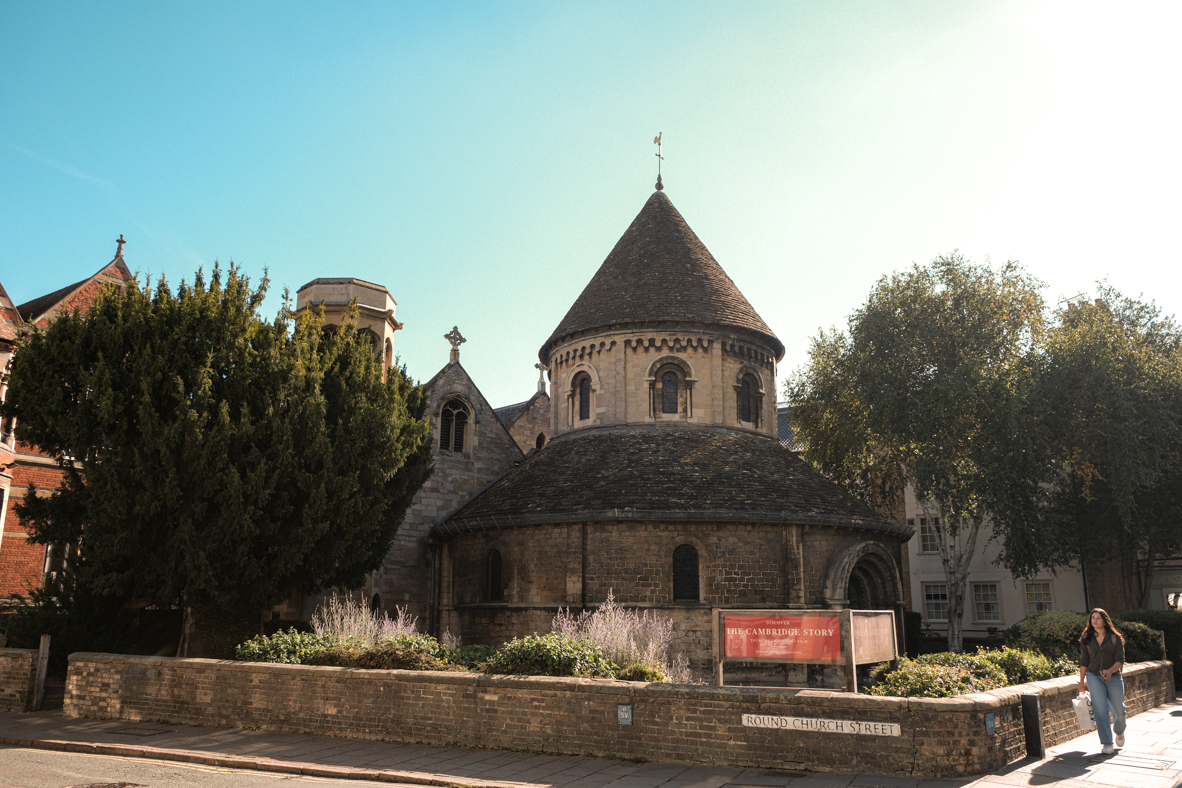
-
The Round Church