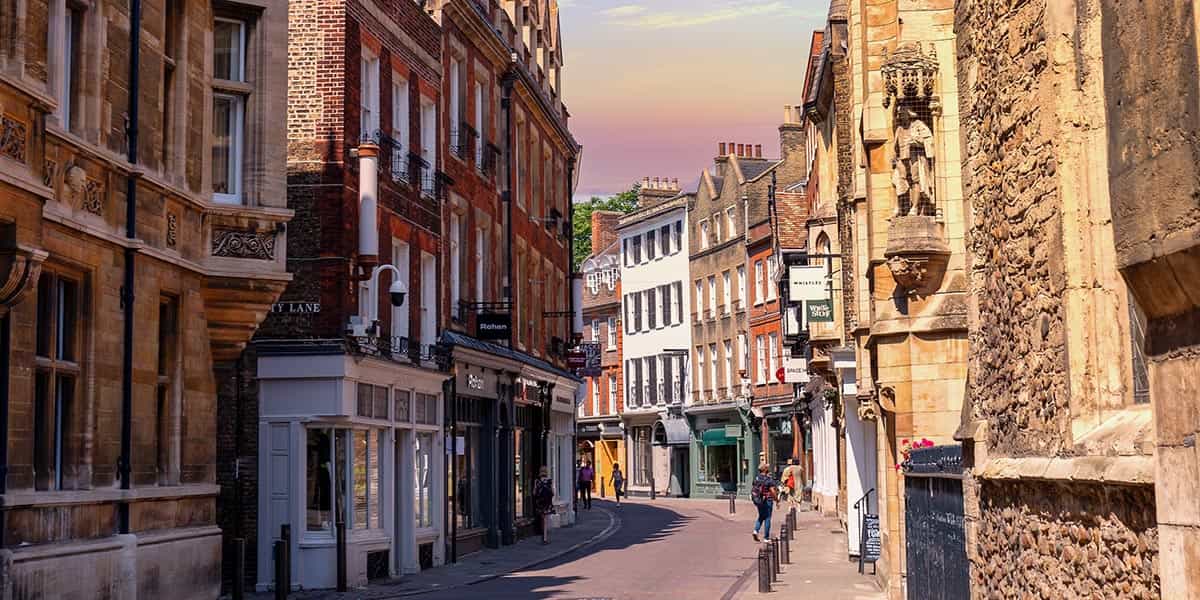
Cambridge History The Foundation of Cambridge University

By the early thirteenth century the town of Cambridge was thriving. It had an internationally renowned annual fair, and was a trading hub for goods from across the UK and Europe. The town centre was packed with markets, churches and homes. But discontent in Oxford was about to have ramifications on Cambridge that would completely alter its future and dramatically change the landscape of the city. Today’s Cambridge is unrecognisable from the trading port of the Middle Ages. And that is due to the emergence of one very important institution: Cambridge University. In this post we will explore the foundation of University of Cambridge and its early years.

Incident at Oxford

Legend states that Oxford University began as early as 872. In this year Alfred the Great happened to meet some monks there and have a scholarly debate lasting several days. But in reality the university really began in the twelfth century when teachers began to lecture and students began to live in the city.

Disaster struck the still fledgling Oxford University in 1209. The exact events remain unknown. But the most detailed account was written in the 1220s by chronicler and monk of St Albans, Roger Wendover. He states:

“a certain clerk engaged in the liberal arts at Oxford killed a certain woman by accident and when he found that she was dead he decided to flee. But when the mayor of the city and many others who had gathered found the dead woman they began to search for the killer in his house which he had rented together with three of his fellow clerks. Not finding the man accused of the deed they seized his three fellow clerks who said they were wholly ignorant of the murder and threw them into prison; then a few days later they were, by order of the King of the English [King John], in contempt of the rights of the church, taken outside the city and hanged.”

Following this incident all members of the University in the city fled. Some fled to existing university towns on the continent. But a small group came to Cambridge where they established what has since become Oxford’s great rival: Cambridge University. It is unknown exactly why they chose Cambridge. Some tried Northampton and Stamford first and it may have been as simple as the fact that there were not many towns that had what Cambridge offered. A moderately-sized town, with cheap lodging, excellent trading links, and where there was no central authority to move them on.

Following this incident all members of the University in the city fled. Some fled to existing university towns on the continent. But a small group came to Cambridge where they established what has since become Oxford’s great rival: Cambridge University. It is unknown exactly why they chose Cambridge. Some tried Northampton and Stamford first and it may have been as simple as the fact that there were not many towns that had what Cambridge offered. A moderately-sized town, with cheap lodging, excellent trading links, and where there was no central authority to move them on.

The Emergence of Cambridge University

Ironically, the men of Oxford fled to Cambridge due to quarrels with the townspeople but found quarrels with Cambridge’s townspeople to be equally bad, if not worse. As a result, many of them returned to Oxford.

The early days of the University are nothing like the huge institution that lives today. There were no colleges and barely any organisation at all. Students had to fend for themselves and find lodgings in the town. They would be taught by any master who could raise enough students willing to attend their lessons. The masters would teach from inside their own private lodgings – the equivalent of classes of students being taught in their teachers’ living rooms today. Pretty much everyone was very young compared to universities today. Today most students are aged 18-21. Back then, the students would be 14 or 15 and the masters themselves were often only 21. But as student numbers began to grow, it became necessary to set up some hostels – lodging houses where students lived under the care of their masters. These were the precursors to later colleges.

The word university actually comes from a translation of the latin word universitas which has a simple meaning: the totality of those licensed to teach – i.e. a collection of teachers. A degree back in the 13th century was nothing more than a license to teach granted once a person was sufficiently expert in their learning.

The early university was a religious body – the chancellor (leader of the university) was confirmed by the bishop of Ely and had ecclesiastical powers. This meant he had jurisdiction over all members of the university and anyone in dispute with them – he was their judge rather than the courts. The earliest members of the university would probably have been religious. The idea of the university was to supply a continuous stream of educated parish priests and monks who could preach and solve intellectual disputes. It is important to note that study of religious texts was an important part of medieval monastic life and so monks needed to be educated and especially taught to read latin.

As a result prayers and religious services were an important part of life at the university. The lives of scholars also had much in common with those of monks, though this was by coincidence not an ideal. Students were forced to live in poverty as many came from families of middling wealth who had to support them through their studies for seven years. And as they lived a communal life made up mainly of men, the monastic ideal of chastity, was also inevitably achieved. The monastic origins of the university also explains the layout of many older colleges where the rooms are arranged around a cloister. As well as the tradition maintained today of collegiate life: eating and drinking as a community with a high table reserved for the most important figures. However, over time, Cambridge colleges moved away from the traditional bare monastic halls once they had the wealth for opulent decorations!

Some students would also go on to serve as civil servants working in the royal household. Consequently, from its early days the university attracted the support of the Crown and royal government. It was important for a monarch to have a supply of well-educated men for his household and so kings knew they needed to support it, even if they did not care for learning. Plus, it was helpful for Cambridge, that if a king forgot to bestow wealth and power on the university, then most of his advisors were alumni who could helpfully remind him…

So overall, the university was made up of small groups of boys in their early teenage years who would attach themselves to a teacher. This group would rent rooms, or perhaps even an entire hostel where they could all live together. This was important as many needed the financial support of being able to share books and resources. Plus, it was also important emotionally. These young boys would be at university for seven years to achieve a first degree and then another decade if they wanted to become a Master in law or theology. Creating something resembling a home-life where they could feel safe and secure was essential!

It is therefore unsurprising that Cambridge University went through the next stage of its evolution less than 100 years after it was established. In 1284, just 75 years after the university began, the first college, Peterhouse was established…

Read more of our history series to hear more about the foundation of Cambridge colleges and what happened to the town and its people after the university moved in
More articles

  • Early Medieval Cambridge

Harry Potter was not filmed in Cambridge, we're sorry to say. However, even though no wizards ever waved their wands here on camera, Cambridge still feels suspiciously magical. In fact, many of the most well known aspects of life at Hogwarts closely resemble regular student life at Cambridge University, likely influencing J.K. Rowling’s portrayal of Hogwarts. Gothic spires, crooked alleyways, and ancient college traditions make it easy to imagine how Hogwarts could be hiding in plain sight.You may not be able to catch the Hogwarts Express from King’s Cross; however, there is a 50-minute direct train to Cambridge, which might be the next best thing.

What Makes Cambridge Feel Like Hogwarts?

Cambridge students in black gowns standing outside the Senate House building
Student graduations outside Senate House

The Colleges

One of the strongest reasons Cambridge feels so familiar to Harry Potter fans is its collegiate system. There’s no Sorting Hat at Cambridge, but before the start of the first year, every student is assigned to 1 of 31 colleges, which becomes their academic and social home for the next three years

Over the years, each college has developed its own distinct culture,originating from the ideas and values of the initial college Masters. Each college has a set of colours, a unique crest, and long-standing traditions that new students must follow. Colleges often compete with one another in sports and academic achievements, creating a sense of rivalry and pride that wouldn't feel out of place at Hogwarts.

These colleges are spread throughout the medieval city, tucked between cobbled alleyways, old pubs, and quiet lanes that seem designed for wandering wizards. Many of these colleges are open to the public, offering plenty of opportunities for Harry Potter–inspired photo moments.

Formal Dinners

One of the most memorable features of Hogwarts life is the dining hall. Similarly, each college within Cambridge holds regular Formal Dinners, which closely resemble the dining experience at Hogwarts — minus the flying silverware.

The actual dining hall used in the Harry Potter films was at Christ Church College, Oxford. However, each Cambridge college is home to a similar hall, with wood-panelled walls covered in portraits of past scholars, professors, and patrons, where formal dinners take place.

Magdalene college dining hall
Magdalene College dining hall

Formal dinners are often held by candlelight and begin with the formal announcement of the college professors, who sit at a high table and lead the meal with a Latin prayer. Academic gowns must be worn, with styles varying by college, faculty, and seniority.

Most college dining halls are closed to visitors; however, the halls at Pembroke College and Trinity College are sometimes open to the public.

Experience the Magic of Cambridge’s Architecture

Many of the college buildings at Oxford, where Harry Potter was filmed, were designed by the same architects responsible for some of Cambridge’s most iconic structures. With many buildings in both university towns constructed during the same era, and in some cases by the same architects, there are striking similarities between the real filming locations in Oxford and the magical atmosphere of the Cambridge colleges.

St.John’s New Court & Bridge of Sighs

St.Johns New Court in september

Often mistaken for Hogwarts—mainly due to a rumour spread by tour guides—the New Court building at St John’s is so convincingly magical that many visitors still assume Harry Potter was filmed here.

The New Court is connected to the older part of the college by the Bridge of Sighs, whose Gothic spires and architectural elegance further enhance the sense of magic throughout the college..

Trinity College and The Wren Library

The Large courts and stone façades of Trinity College are instantly recognisable to fans of the films. 

The Wren library
The Wren library bookcases

The Wren Library deepens that impression, with dark wooden shelves, historic interiors, and centuries-old books that feel as though spells and secrets might be hidden among the pages.

King's College Chapel

Spires of Kings College Chapel at Dusk
Spires of King's College Chapel at Dusk

King’s College Chapel is one of the most memorable places to visit in Cambridge. During Evensong, the space fills with choral music that echoes beneath the vast stone ceiling, creating an experience that feels both peaceful and dramatic.

Rose Crescent and Green Street

Rose Crescent and Green Street are narrow, cobbled streets that curve gently away from Kings Parade. Lined with independent shops which feel tucked away and slightly secret. Harry Potter gift shops sit alongside cafés and boutiques to create a magical storybook atmosphere.

Harry Potter Actors with Cambridge Connections

Cambridge also has direct links to the Harry Potter cast. Emma Thompson, who played Professor Sybill Trelawney, studied English at Newnham College, Cambridge, and was a member of the Footlights comedy group.

Eddie Redmayne, who played Newt Scamander in the Fantastic Beasts films, studied History of Art at Trinity College, Cambridge. Together, these connections add another quiet layer to Cambridge’s relationship with the wizarding world.

Real Harry Potter Filming Locations

From Cambridge, it is easy to travel to many of the real Harry Potter filming locations elsewhere in the UK.

London

London also features heavily. King’s Cross Station became the gateway to Platform 9¾ and remains the same station offering a one-hour direct train to Cambridge. Elsewhere in the city, Leadenhall Market was transformed into Diagon Alley.

Oxford

Oxford played a key role. Christ Church College inspired the Hogwarts dining hall, with its staircase used directly in filming. The Bodleian Library appeared as the Hogwarts library, while the Divinity School next door became Hogwarts Hospital.

Durham

Durham Cathedral was used as Hogwarts classrooms and cloisters, its Romanesque architecture perfectly suited to the wizarding school.

Further north

Alnwick Castle provided Hogwarts exteriors, including the scenes where students first learned broomstick flying.

Scotland

The Scottish Highlands provided the backdrop for some of the most iconic scenes in the series. Glenfinnan Viaduct appears repeatedly as the route of the Hogwarts Express, while the dramatic landscapes around Fort William were used during the Triwizard Tournament. Nearby Loch Shiel featured in the memorable scene where Harry flies Buckbeak.

The Magic of Cambridge

Cambridge may not have been a filming location for Harry Potter, but its atmosphere feels unmistakably magical. With Gothic spires, candlelit Formal Dinners, ancient libraries, and centuries-old college traditions, the city closely mirrors many of the most iconic elements of Hogwarts. Visitors can wander cobbled lanes between historic colleges, admire enchanting architecture such as King’s College Chapel and St John’s Bridge of Sighs, and experience the timeless rituals of university life that seem lifted from the wizarding world.

Beyond its own spellbinding setting, Cambridge is perfectly positioned for fans eager to explore real Harry Potter filming locations across the UK, from King’s Cross Station in London to Oxford’s Christ Church College and the Scottish Highlands. Add in connections to cast members who once studied at Cambridge, and the city’s link to the wizarding world becomes even more compelling.

For travellers seeking history, beauty, and a touch of magic, Cambridge offers an unforgettable experience — no wands required.

[post_title] => Harry Potter In Cambridge [post_excerpt] => [post_status] => publish [comment_status] => closed [ping_status] => closed [post_password] => [post_name] => harry-potter-in-cambridge [to_ping] => [pinged] => [post_modified] => 2026-02-25 16:05:03 [post_modified_gmt] => 2026-02-25 16:05:03 [post_content_filtered] => [post_parent] => 0 [guid] => https://www.remember-cambridge.co.uk/?post_type=article&p=829 [menu_order] => 0 [post_type] => article [post_mime_type] => [comment_count] => 0 [filter] => raw ) 1 -->
  • Harry Potter In Cambridge

  • Cambridge Town & Gown